The Bad Astronomer writes "HD 10180 is a near-twin of the Sun about 130 light years away. It's known to have at least six planets orbiting it, but a new analysis of the data shows clear indications of three more, for a total of nine! This means HD 10180 has more planets than our solar system. And whether you think Pluto is a planet or not, all nine of these aliens worlds have masses larger than Earth's, putting them firmly in the 'planet' category."Slashdot.org
Showing posts with label extrasolar planet. Show all posts
Showing posts with label extrasolar planet. Show all posts
Sunday, 8 April 2012
Possibly nine planets around Sun lookalike

Monday, 16 January 2012
Gaia: using astrometry to discover extrasolar planets
 To date, most extrasolar planets have been discovered using the radial velocity method, where a periodic shift of a star's spectrum betrays a planetary companion. Up and coming is the transit method, used by the Kepler spacecraft to detect exoplanets passing in front of their parent stars.
Even though it's still behind radial velocity in terms of planets discovered, this method is playing catch-up fast: there are already thousands of KOIs (Kepler Object of Interest), or exoplanet candidates detected by Kepler that await confirmation using other methods.
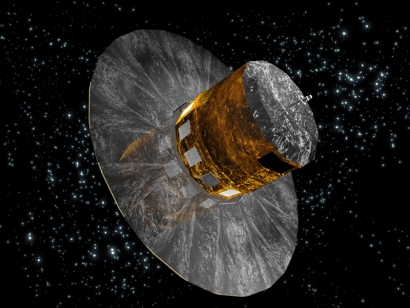
From 2013, the Gaia spacecraft could potentially shift the balance to astrometry as a major planet discovery method. Its mission is to determine star's positions on a scale much more detailed than is possible from Earth, thereby creating a 3-dimensional map of the Galaxy. If a star has a big enough planet, it will wobble and therefore periodically change it's position in the sky. In this ESA presentation from November 2010 (PPT), it is claimed that Gaia could detect planets down to 10 Earth masses:
Results expected:~2000 exo-planets (single systems)~300 multi-planet systemsdisplacement for 47 UMa = 360 μasorbits for ~1000 systemsmasses down to 10 MEarth to 10 pc
Subscribe to:
Posts (Atom)