Thursday, 19 January 2012

Paper on direct imaging of exoplanets

Some takeaways on direct imaging of exoplanets from a scientific paper at arXiv:

Extra-solar planets or candidates as close to their host star as the Solar System planets (within
30 AU) are still very rare with β Pic b, HR 8799 e, PZ Tel B/b, and HR 8799 d being the only exceptions at 8.5, 14.3, 18.3, and 24.2 AU, respectively, all nearby young stars (19 to 52 pc). As far as angular separation is concerned, the closest planets or candidates imaged directly are PZ Tel B/b, HR 8799 e, β Pic b, HR 8799 d, and GQ Lup b with separations from 0.36 to 0.75 arc sec. 
New AO imaging techniques like ADI, SAM, and locally optimized combination of images
have improved the ability to detect such planets. Future AO instruments at 8-meter ground-based telescopes will improve the accessible dynamic range even further. Imaging with a new space based telescope like JWST (Beichman et al., 2010) or AO imaging at an extremely large telescope of 30 to 40 meters would improve the situation significantly. Imaging detection of planets with much lower masses, like e.g. Earth-mass planets, might be possible with a space-based interferometer like Darwin or TPF, but also only around very nearby stars.
Direct Imaging of Extra-solar Planets - Homogeneous Comparison of Detected Planets and Candidates (via @AllPlanets)

Public planet hunting goes live on BBC, participant discovers planet


As long as I can name my own planets, I want in! Following previous news that Planethunters.org gets +1million classifications, the BBC reports:

The public push initiated on BBC Two's Stargazing Live series to find planets beyond our Solar System has had an immediate result.

A viewer who answered the call has helped spot a world that appears to be circling a star dubbed SPH10066540.

The planet is described as being similar in size to our Neptune and circles its parent every 90 days.

Chris Holmes from Peterborough found it by looking through time-lapsed images of stars on Planethunters.org.

The website hosts data gathered by Nasa's Kepler space telescope, and asks volunteers to sift the information for anything unusual that might have been missed in a computer search.

"I've never had a telescope. I've had a passing interest in where things are in the sky, but never had any more knowledge about it than that," Mr Holmes told BBC News.

"Being involved in a project like this and actually being the one to find something is a very exciting position."

Chris Lintott from Oxford University who helps organise Planethunters.org added: "We're ecstatic. We've been groaning under the strain of all these people who want to help us, which is exactly how it should be."

The public participation project was launched last year, but it got a huge fillip when it was featured in the popular Stargazing series' return to BBC Two on Monday.

Volunteers have tripled to more than 100,000 people, and the number of images inspected has now reached a million.

Stargazing viewer in planet coup

Wednesday, 18 January 2012

Exoplanets have sunsets too, although their color might be a bit offsetting

Ever wondered what a sunset (or rather, starset) will look like on an exoplanet? A new website, exoclimes.com, has been launched that "is devoted to discussion around the study of planetary atmospheres outside the Solar System":
Extrasolar planets orbit stars, in a similar way to the Earth orbiting the Sun. Professor Frédéric Pont of the University of Exeter has used the extrasolar planets' 'transmission spectrum', taken by the Hubble Space Telescope, to work out the colour of the 'sunsets' created by these stars.

Writing on the website exoclimes.com, where he has posted the two sunset images he has produced, Professor Pont said:  "Unlike its sister planet HD '189, the planet HD '209 ('Osiris') has a sunset that looks truly alien. The star is white outside the atmosphere, since its temperature is close to that of the Sun. It then acquires a bluish tinge as it sinks deeper, because the absorption by the broad wings of the neutral sodium lines (the spectral lines responsible for the gloomy orange of sodium street lighting) remove the red and orange from the star light.

"One key difference with a sunset on Earth is that the 'sun' is much larger from '209, because the planet is very close. Instead of changing colour as it moves near the horizon, the host star spans all colours at once."
The Science of Sunsets

Planethunters.org gets +1million classifications

Thanks to your help and BBC Stargazing, we managed 1,084,760 classifications in 48 hours. 
There's still more to do, and more discoveries to be made, so keep clicking!
As written on planethunters.org (via prof. Brian Cox, everyone's favourite astrophysicist).

Monday, 16 January 2012

Video showing radius, orbit and surface temperature of candidate exoplanets

This video has been around but I'm only coming across it now, via NASA--beautiful!


Kepler Exoplanet Candidates from blprnt on Vimeo.

As far as I can tell, this video is based on the February 2011 batch of KOIs; I wonder what it will look like using the updated KOI database (containing ±1000 more candidates).

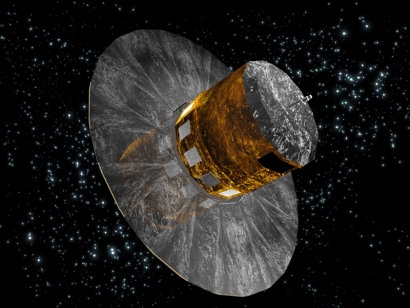
Gaia: using astrometry to discover extrasolar planets


To date, most extrasolar planets have been discovered using the radial velocity method, where a periodic shift of a star's spectrum betrays a planetary companion. Up and coming is the transit method, used by the Kepler spacecraft to detect exoplanets passing in front of their parent stars.

Even though it's still behind radial velocity in terms of planets discovered, this method is playing catch-up fast: there are already thousands of KOIs (Kepler Object of Interest), or exoplanet candidates detected by Kepler that await confirmation using other methods.

From 2013, the Gaia spacecraft could potentially shift the balance to astrometry as a major planet discovery method. Its mission is to determine star's positions on a scale much more detailed than is possible from Earth, thereby creating a 3-dimensional map of the Galaxy. If a star has a big enough planet, it will wobble and therefore periodically change it's position in the sky. In this ESA presentation from November 2010 (PPT), it is claimed that Gaia could detect planets down to 10 Earth masses:
Results expected:
~2000 exo-planets (single systems)
~300 multi-planet systems
displacement for 47 UMa = 360 μas
orbits for ~1000 systems
masses down to 10 MEarth to 10 pc

Sunday, 15 January 2012

Will 2012 be the year of Earth sized exoplanets? Trend says yes

The graph on the right (from Exoplanets.eu) is a simple correlation plot, graphing planet mass against year of discovery*. Apart from 1992 (when 3 planets were discovered around a pulsar), the lower bound on exoplanet mass seems to decrease every year.

If this trend continues, we might see a number of exciting discoveries in 2012; after all, the lower a planet's mass, the more it resembles Earth (in rough terms). Actually, the party has already started with the discovery of 3 sub-earth sized planets last week.

If 2011 was the year of super-earths, then will 2012 be the year of Earth sized exoplanets?

*Note that only sub-Jupiter-sized planets are shown.